
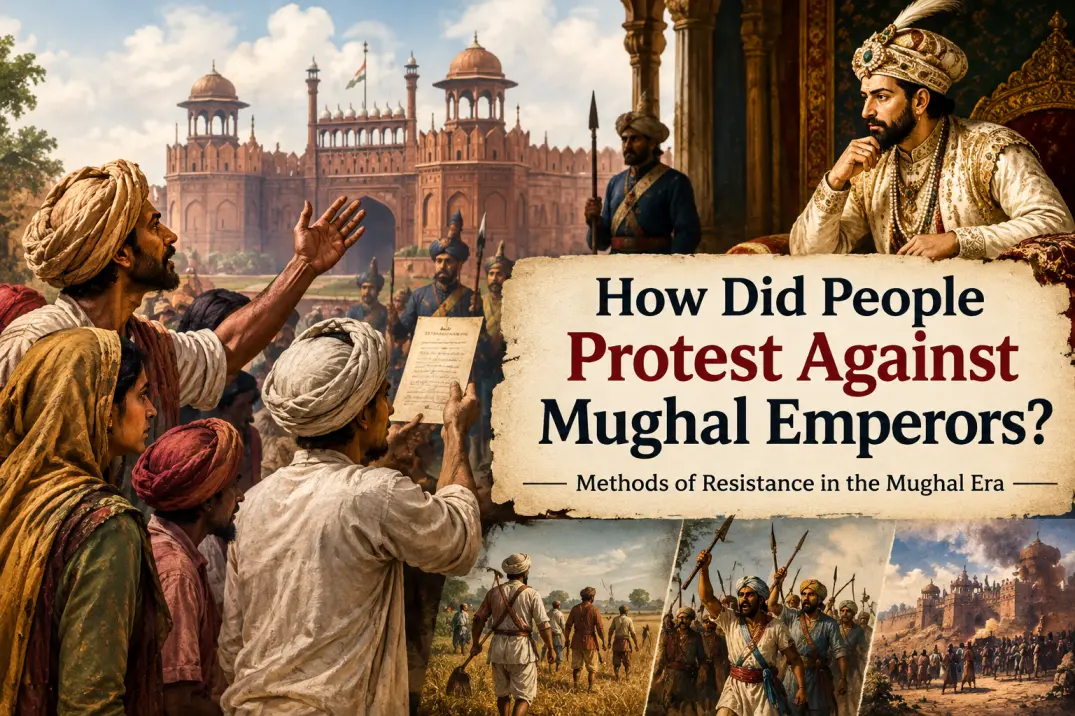
During the Mughal period, people did not have the same democratic rights or organised protest platforms that exist today. However, farmers, local chiefs, zamindars and ordinary citizens found different ways to express their dissatisfaction with the rulers. Their resistance often arose from heavy taxation, unfair treatment by officials and attempts to restrict local power.
How Did People Express Their Anger During Mughal Rule?
Unlike modern India, where people can organise rallies, demonstrations and public campaigns, the Mughal Empire was governed through a centralised system of royal authority. The emperor, his officials and regional power holders controlled administration and revenue collection.
For ordinary people, challenging the authorities was difficult. As a result, resistance often took practical forms, such as refusing to pay taxes, leaving villages, submitting complaints to the royal court or organising larger rebellions.
1. Farmers Refused to Pay Taxes
Agriculture was a major source of revenue for the Mughal Empire. Farmers were expected to pay taxes on their agricultural production, and excessive demands could create serious financial difficulties, particularly after poor harvests.
When revenue collection became unbearable, some farmers refused to pay. In certain cases, entire groups of villagers abandoned their homes and moved to other areas in search of safety or better living conditions.
Such actions could affect the administration because deserted villages meant reduced agricultural production and lower tax revenue for the state.
2. Complaints and Petitions to the Royal Court
Not every form of resistance involved violence. People who faced injustice from local officials could seek help by submitting petitions or presenting their grievances through influential individuals who had access to the royal court.
These complaints could concern unfair taxation, abuse of authority or disputes involving government officials. However, approaching the emperor or senior administrators was not equally easy for everyone. People with money, social standing or influential connections often had better access to the system.
Petitions therefore provided a possible route to seek justice, although their success depended on the circumstances and the authorities involved.
3. Zamindars and Regional Leaders Challenged Mughal Authority
The Mughal Empire relied on a complex network of regional chiefs, zamindars and local administrators. Although the emperor exercised supreme authority, local power holders could retain considerable influence in their territories.
Conflicts arose when imperial officials attempted to increase revenue demands or interfere with local privileges. In response, some regional leaders withheld revenue payments, strengthened their forts or gathered armed supporters to challenge Mughal forces.
These confrontations were not always simply protests against the emperor. They could also involve disputes over territory, political independence, revenue collection and control over local resources.
4. Jat Farmers Organised Resistance
During the seventeenth century, Jat communities in the Mathura region became involved in resistance against Mughal authority. Their opposition was influenced by local grievances and conflicts with imperial officials.
Over time, some of these confrontations developed into broader, organised uprisings. They demonstrated how dissatisfaction within rural communities could grow into a significant political and military challenge.
The Jat resistance also reflected the difficulties the Mughal administration sometimes faced in maintaining control over distant rural areas.
5. The Satnami Rebellion of 1672
One of the notable uprisings during Aurangzeb’s reign was the Satnami rebellion of 1672, associated with the Narnaul region in present-day Haryana.
The conflict developed after tensions between the Satnamis and Mughal authorities escalated. Members of the community organised resistance against imperial forces, turning a local confrontation into a larger rebellion.
The Mughal administration eventually responded with military force. The episode illustrates how disputes involving local communities and officials could escalate when grievances were not resolved peacefully.
Were There Any Rules for Protesting During the Mughal Period?
There was no single, nationwide protest framework comparable to the legal system governing public demonstrations in modern India. Political authority was concentrated in the emperor and his administration, and people did not enjoy the same constitutional guarantees of freedom of assembly and expression.
The response to opposition depended on its nature, the people involved and the perceived threat to imperial authority.
- Petitions and complaints: People could seek redress through officials or the royal court.
- Tax resistance: Refusing to pay revenue could lead to disputes with administrators.
- Migration: Leaving a village could be a way to escape oppressive conditions.
- Armed rebellion: Organised resistance against imperial forces could result in severe punishment.
Not all resistance was peaceful, and the authorities could use military force to suppress uprisings. These historical practices must be understood within the political and social conditions of the time.
How Were Mughal-Era Protests Different From Modern Demonstrations?
The biggest difference lies in the political system. Modern India has a Constitution that protects the right to assemble peacefully, subject to reasonable legal restrictions. Citizens can organise demonstrations, raise public demands and challenge government decisions through established democratic institutions.
During Mughal rule, opposition generally operated within a system where the emperor held ultimate authority. People often had to rely on petitions, local influence, economic pressure or rebellion rather than constitutionally protected public protest.
Conclusion
Resistance during the Mughal era took many forms, from farmers refusing to pay taxes and villagers leaving their homes to petitions submitted to the royal court and large-scale uprisings. The Jat resistance and Satnami rebellion are examples of how local grievances could develop into wider challenges to imperial power.
Although these actions differed considerably from today’s democratic protests, they reveal an important historical reality: people continued to find ways to challenge authority when they believed their livelihoods, rights or local interests were under threat.

1 comment
[…] How Did People Protest Against Mughal Emperors? Methods of Resistance in the Mughal Era […]