
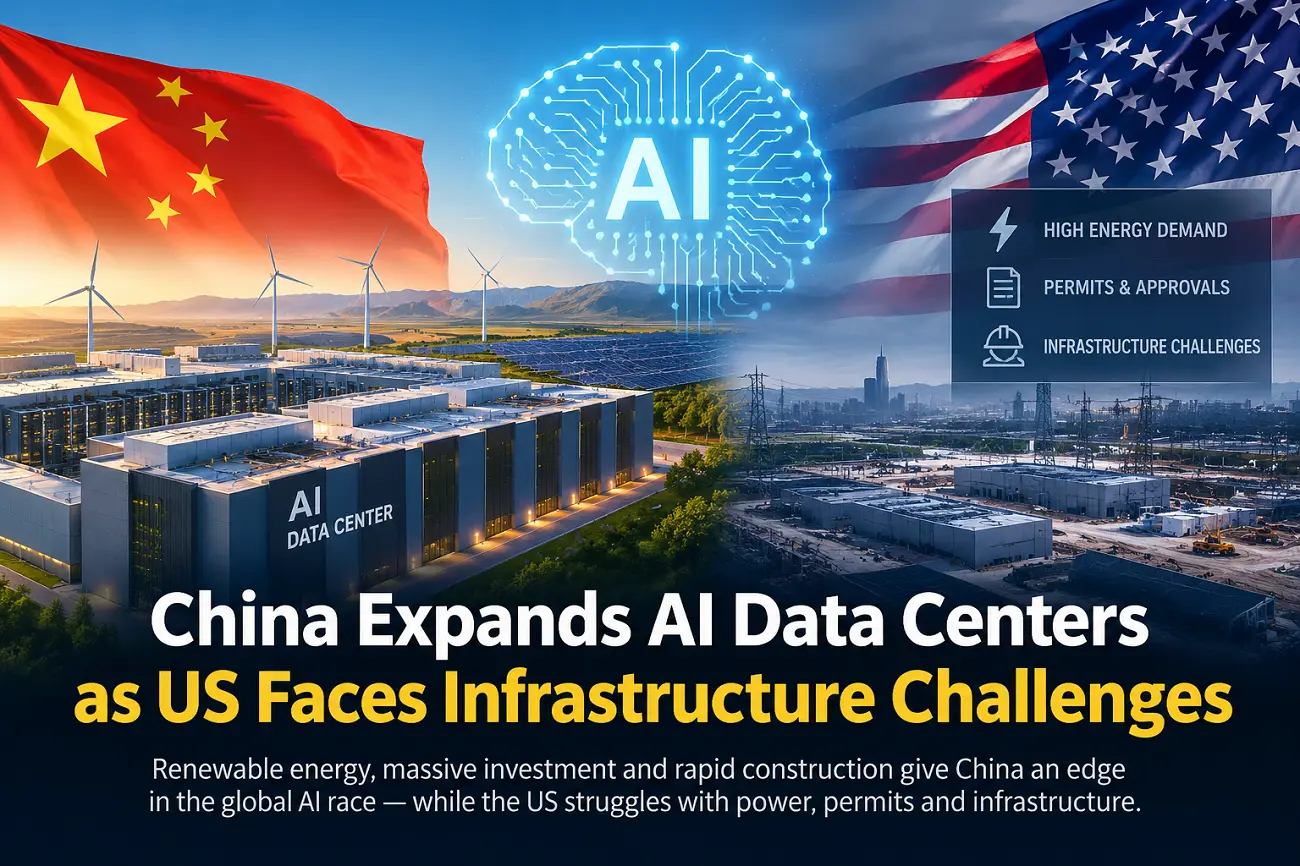
China is rapidly expanding its artificial intelligence infrastructure, using renewable energy, large-scale construction and government-backed investment to strengthen its position in the global AI race.
China is accelerating the development of artificial intelligence (AI) data centres as competition with the United States intensifies. While data center projects in the US face growing concerns over electricity demand and local opposition, China is moving ahead with large computing facilities designed to support its expanding AI industry.
One of the major examples of this expansion is Ulanqab, a city in Inner Mongolia that is emerging as an important hub for China’s digital infrastructure. Nearly 90 data center projects are planned in the area, attracting technology companies and infrastructure developers.
China Invests Heavily in AI Infrastructure
The expansion reflects Beijing’s broader strategy to make artificial intelligence a major driver of economic growth. China’s government announced a $560 billion initiative last month to strengthen information infrastructure, including computing capacity, over the next five years.
Private technology companies are also increasing their investments in AI infrastructure. However, their spending remains considerably lower than that of major US technology companies.
China’s AI ambitions are supported by rapid construction, government coordination and the availability of large areas of land. These factors allow developers to establish data centers at a pace that can be difficult to achieve in regions facing lengthy approval processes or infrastructure constraints.
Renewable Energy Gives China an Advantage
Access to affordable electricity is becoming increasingly important as AI models require more computing power. China is seeking to use its expanding renewable energy capacity to support the growth of data centers.
Inner Mongolia offers favorable conditions for this strategy, including strong wind resources, solar energy potential and a relatively cool climate. These advantages can help reduce electricity costs associated with cooling and operating large server facilities.
China’s “Eastern Data, Western Computing” strategy aims to locate computing infrastructure in western regions where energy and land are more readily available, while serving demand from more populated eastern cities.
The initiative includes designated national computing hubs and data center clusters intended to connect energy resources with growing digital demand.
Advanced Chips Remain a Major Challenge
Despite its infrastructure expansion, China continues to face difficulties accessing some of the world’s most advanced AI processors.
US export restrictions have limited Chinese companies’ access to high-end chips from companies such as Nvidia and AMD. Domestic manufacturers, including Huawei, are working to develop alternative technologies, but supply and performance limitations remain challenges.
Chinese companies are also combining multiple processors to increase computing capacity. Although this approach can support certain AI workloads, it may require additional electricity compared with more advanced hardware.
This highlights an important distinction in the global AI race: constructing more data centers does not automatically guarantee superior computing performance.
Data Centers Turn Toward Cleaner Power Sources
Companies are exploring new ways to reduce the environmental impact of AI infrastructure. In Ulanqab, Envision’s Galaxy Campus is being developed with plans to obtain more than 80% of its electricity directly from company-operated wind farms, according to information provided to CNN.
The project is planned to reach a total capacity of 2 gigawatts in phases. Battery storage and advanced power management systems are also intended to help manage changes in renewable electricity supply.
The region’s cooler climate can further reduce cooling requirements, while specialized cooling systems may help limit water consumption.
However, questions remain about whether every planned facility will attract enough customers or secure the necessary computing hardware to justify its construction.
What China’s Expansion Means for the Global AI Race
China’s rapid development of data centers demonstrates how electricity supply, computing hardware and infrastructure investment are becoming essential components of AI competitiveness.
The US retains significant advantages in advanced chips, private-sector investment and computing resources. China, meanwhile, is attempting to narrow the gap through large-scale construction, coordinated infrastructure planning and increased use of renewable energy.
The effectiveness of this strategy will depend on whether China can secure sufficient advanced hardware, manage electricity consumption and ensure that new facilities meet genuine demand.
As AI adoption continues to grow, the competition between the two countries is likely to depend not only on the development of more powerful AI models but also on the infrastructure required to operate them at scale.
