
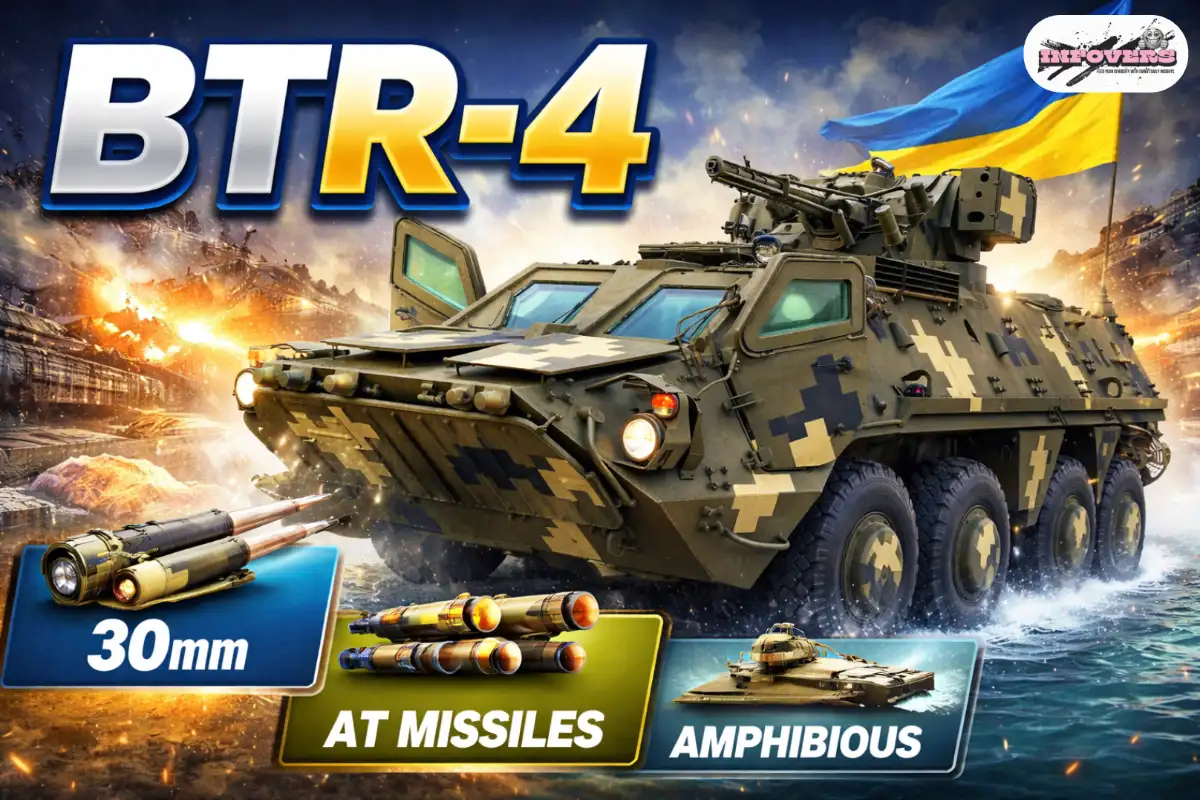
The BTR-4 is one of the most well-known modern armored fighting vehicles produced by Ukraine. It is an 8×8 wheeled Infantry Fighting Vehicle (IFV) that transports soldiers safely while delivering heavy firepower on the battlefield. Over the years, the BTR-4 has gained attention not only for its modern design but also for its use in real combat zones such as the Russo-Ukrainian War, operations against ISIS, and conflicts in Africa.
Many people compare the BTR-4 to older Soviet-era BTR vehicles like the BTR-80. However, the BTR-4 is considered a more modern platform because it follows a design closer to Western armored vehicles, especially in its internal layout, protection upgrades, and modular weapon systems.
In this article, we will explain everything about the BTR-4, including its history, specifications, design, variants, combat record, operators, and why it matters in modern warfare.
What is the BTR-4?
BTR-4 Bucephalus is a Ukrainian-made armored vehicle that mainly functions as an Infantry Fighting Vehicle (IFV). Unlike a simple troop carrier, an IFV transports soldiers and fights directly using cannons, machine guns, and missiles.
The vehicle is amphibious, meaning it can cross rivers and water bodies without requiring bridges. This is an important feature in modern warfare because many military operations require fast movement across difficult terrain.
BTR-4 comes from the Kharkiv Morozov Machine Building Design Bureau, one of Ukraine’s most important defense engineering organizations.
Quick Overview of BTR-4 (Specifications Table)
| Category | Details |
|---|---|
| Name | BTR-4 Bucephalus |
| Type | Infantry Fighting Vehicle (IFV) |
| Origin | Ukraine |
| Manufacturer | Kharkiv Morozov Machine Building Design Bureau (KMDB) |
| Service Entry | 2009 (Ukraine), widely used from 2014 |
| Drive System | 8×8 wheeled |
| Crew | 3 (driver, commander, gunner) |
| Passenger Capacity | 8 troops |
| Main Weapon | 30 mm 2A72 autocannon |
| Secondary Weapons | 7.62 mm machine gun + AT missiles + grenade launcher |
| Armor | Welded steel (upgradable with extra protection) |
| Speed (Road) | Up to 110 km/h |
| Speed (Water) | Up to 10 km/h |
| Operational Range | Around 690 km |
| Engine | 3TD diesel / Deutz EURO III |
| Horsepower | 489–598 hp |
Why the BTR-4 is Important in Modern Warfare
The BTR-4 is important because it represents Ukraine’s attempt to build a modern armored vehicle that competes with NATO-style designs while still being affordable for mass production.
It is designed for:
- rapid troop transport
- urban warfare combat
- anti-tank missile operations
- infantry support missions
- amphibious river crossings
- battlefield reconnaissance variants
The modular design allows the vehicle to be modified depending on the mission. That flexibility makes it a strong platform for both national defense and exports.
BTR-4 Development and History
Prototype and Early Development (2006)
The BTR-4 project was first shown publicly in 2006 during the Aviasvit exhibition in Kyiv. It was originally developed as a private venture, which means it was not fully funded as a state project at the beginning.
The main goal was to create a next-generation armored vehicle to replace older Soviet-era models.
Production Starts (2008–2009)
Serial production started around late 2008. By 2009, Ukraine received the first batch of about ten BTR-4 vehicles. This was the first major step toward making the BTR-4 a real operational vehicle.
Iraq Contract and Major Export Attempt (2012)
A major turning point came in 2012 when Iraq ordered around 420 BTR-4E vehicles. This was supposed to be one of Ukraine’s largest military export deals.
However, the contract became controversial because Iraq reported issues with vehicle quality. Due to these complaints, the Iraqi government cancelled the contract after receiving only a limited number of vehicles.
Some of the rejected BTR-4 vehicles were later taken into Ukrainian service.
This event was both a setback and a lesson for Ukraine’s defense industry because it highlighted the importance of quality control in defense exports.
BTR-4 Entering Real Combat (2014–Present)
The BTR-4 became widely used in real war conditions starting in 2014, during the early phases of the conflict in eastern Ukraine.
Sloviansk Battle (2014)
In April 2014, Ukraine’s National Guard received BTR-4E vehicles. By May–June, they were already being used in combat, especially during the operations around Sloviansk.
Reports from Ukrainian soldiers described the BTR-4 as:
- fast and mobile
- better protected than older BTR models
- equipped with strong optics
- capable of surviving machine gun fire and some RPG hits
This was the first major battlefield test for the BTR-4.
Russo-Ukrainian War (2022–2026)
After Russia’s full-scale invasion of Ukraine in 2022, BTR-4 vehicles were heavily used in frontline operations.
They became one of the main wheeled IFVs in Ukraine’s forces due to their speed, amphibious capability, and modular weapons.
Design and Layout of the BTR-4
One of the biggest improvements in the BTR-4 compared to older Soviet BTR vehicles is its internal layout.
Older Soviet BTR Layout Problem
Vehicles like BTR-60, BTR-70, and BTR-80 had side doors that forced troops to exit dangerously near the middle of the vehicle. This could expose soldiers to enemy fire.
BTR-4 Layout Advantage
The BTR-4 has a more Western-style design:
- driver and commander at the front
- engine in the middle
- troop compartment at the rear
- rear doors or ramp exit for soldiers
This makes troop deployment much safer, especially during urban warfare.
The rear exit stands as one of the most important improvements because soldiers can exit quickly under cover.
Armor and Protection
The BTR-4 uses welded steel armor as its basic protection. However, its design allows extra protection upgrades.
Protection Features
Depending on the configuration, the BTR-4 can include:
- slat armor (anti-RPG protection)
- Kevlar spall liners (reduces shrapnel damage inside)
- ceramic armor plates
- explosive reactive armor (ERA) on upgraded variants
The later version BTR-4MV1 is designed to meet higher NATO protection levels.
Mobility and Amphibious Capability
The BTR-4 is a wheeled 8×8 vehicle, which gives it excellent road mobility.
Speed and Range
- Maximum road speed: 110 km/h
- Range: around 690 km
This makes it very useful for quick troop movement, supply convoys, and rapid deployment missions.
Water Crossing
The vehicle can travel in water at about 10 km/h, which is useful for crossing rivers during military operations.
This amphibious feature is a major advantage because many armored vehicles require bridges or special transport to cross water.
Weapons and Firepower
The BTR-4 is not just a transport vehicle—it is heavily armed.
Main Weapon: 30mm Autocannon
Most variants use the 2A72 30mm autocannon, which can destroy:
- infantry positions
- light armored vehicles
- enemy trucks and fortifications
- drones and low-flying helicopters (in some cases)
Secondary Weapons
The BTR-4 often includes:
- 7.62mm coaxial machine gun
- anti-tank guided missiles (ATGMs) such as Konkurs or Baryer
- automatic grenade launcher (30mm) in some configurations
Anti-Tank Missile Capability
The anti-tank missile system makes the BTR-4 dangerous even against heavier armored targets.
This allows the vehicle to support infantry by engaging enemy tanks from a distance.
Weapon Modules (Turret Options)
One of the most flexible parts of the BTR-4 design is that it can use multiple weapon modules.
Some major modules include:
- GROM module
- PARUS module
- SHTURM-M module
- SHKVAL module
- BAU 23×2 module
This modularity is important because different countries can choose different weapons depending on their military needs.
BTR-4MV1: NATO-Standard Upgrade
The BTR-4MV1 is considered the most advanced version of the BTR-4.
Key Improvements in MV1
- improved hull design
- higher protection levels
- ability to mount ceramic and reactive armor
- rear ramp for faster troop exit
- designed closer to NATO standards
The MV1 is Ukraine’s attempt to modernize the BTR-4 to meet Western battlefield requirements.
BTR-4 Combat Record
The BTR-4 has been used in multiple conflicts.
War Against ISIS
Iraqi forces used BTR-4 vehicles in operations against ISIS, including major battles like:
- Jurf al-Nasr
- Ar-Rutbah
Russo-Ukrainian War
The BTR-4 has been actively used since 2014 and continues to be used during the 2022–2026 war period.
It has been seen in:
- frontline assaults
- defense operations
- mechanized infantry missions
- convoy protection roles
Boko Haram Conflict (Nigeria)
Nigeria received BTR-4 vehicles and used them in internal conflict operations, including battles involving Boko Haram and ISWAP.
BTR-4 Operators (Countries Using It)
Current Operators
The BTR-4 has been used or acquired by several countries, including:
Ukraine
Ukraine is the primary operator, using the BTR-4 widely in both the army and National Guard.
Iraq
Iraq initially ordered hundreds of BTR-4s but cancelled the full contract due to reported quality issues. However, Iraq still operates a significant number of vehicles.
Nigeria
Nigeria received BTR-4 units and used them in internal military operations.
Indonesia
Indonesia tested and purchased a small batch of BTR-4 vehicles but reportedly stopped further acquisition later.
Myanmar
Myanmar has been linked with cooperation for producing BTR-4E vehicles locally.
Captured BTR-4 Vehicles
During wars, enemy forces sometimes capture and reuse armored vehicles.
Captures by Separatists / Russian Forces
During the Russo-Ukrainian War, opposing forces captured some BTR-4 vehicles and reportedly reused them.
Captures by ISIS
ISIS also captured a small number of BTR-4 vehicles from Iraqi forces.
This shows that the vehicle operates in high-intensity conflict zones where forces often lose and capture equipment.
BTR-4 Variants (All Major Versions Explained)
The BTR-4 is available in multiple variants, each designed for different battlefield roles.
1. BTR-4E / BTR-4E1
The export version and one of the most widely known variants.
2. BTR-4K
Command vehicle version designed for battlefield coordination.
3. BTR-4KSh
Command and staff vehicle with extra communication equipment.
4. BRM-4K
Reconnaissance version used for scouting missions.
5. BREM-4K
Repair and recovery vehicle used to tow damaged armored units.
6. BSEM-4K
Medical evacuation and recovery variant.
7. BTR-4MV / BTR-4MV1
Modernized NATO-style version with stronger protection and improved design.
8. MOP-4K
Fire support version with heavy weapons like a 120mm cannon.
9. BMM-4A / BMM-4B / BMM-4C
Medical support versions used for battlefield evacuation and field treatment.
These variants show how the BTR-4 is not a single vehicle but a whole family of armored systems.
Strengths of the BTR-4
The BTR-4 has several major advantages:
Excellent Speed and Mobility
Wheeled vehicles are faster than tracked vehicles on roads, and the BTR-4 is built for rapid deployment.
Strong Firepower
The combination of a 30mm cannon, machine gun, grenade launcher, and anti-tank missiles makes it deadly in combat.
Safer Troop Exit Design
The rear troop compartment design improves survivability for infantry.
Modular Weapon System
Different turrets and weapons can be installed depending on customer needs.
Amphibious Capability
Water crossing ability gives it flexibility in tactical operations.
Weaknesses and Criticism
Despite being advanced, the BTR-4 has also faced criticism.
Quality Control Issues
The Iraq contract cancellation damaged the reputation of the BTR-4 because of reported problems such as rust, damaged hulls, and build quality concerns.
Protection Against Heavy Weapons
While effective against small arms and some RPG attacks, it may not survive heavy anti-tank guided missiles or modern tank shells.
Maintenance Challenges in Harsh Environments
Some operators have complained about performance issues, especially in extreme climates.
BTR-4 vs Older BTR Vehicles (Main Differences)
The BTR-4 is often compared to BTR-80 and BTR-82.
Here are the biggest differences:
- BTR-4 has a rear troop exit (safer)
- BTR-4 uses modular turrets (more flexible)
- BTR-4 has better optics and targeting systems
- BTR-4 is designed closer to Western IFV layouts
- BTR-4 has stronger missile options
This makes it a more modern and battlefield-adapted platform.
Conclusion: Why the BTR-4 Still Matters Today
The BTR-4 is one of Ukraine’s most important armored vehicle developments. It represents a major shift away from Soviet-style armored designs toward a more modern, NATO-inspired approach.
Even though the vehicle faced export challenges and criticism, it has proven itself in real combat conditions, especially in Ukraine’s defense operations since 2014 and during the large-scale war after 2022.
With variants like the BTR-4MV1, Ukraine continues to upgrade the platform, making it more competitive and survivable in modern warfare.
Overall, the BTR-4 remains a powerful and flexible IFV that combines mobility, troop transport, and heavy firepower—making it one of the most important armored vehicles in Ukraine’s arsenal today.
Read More Also